
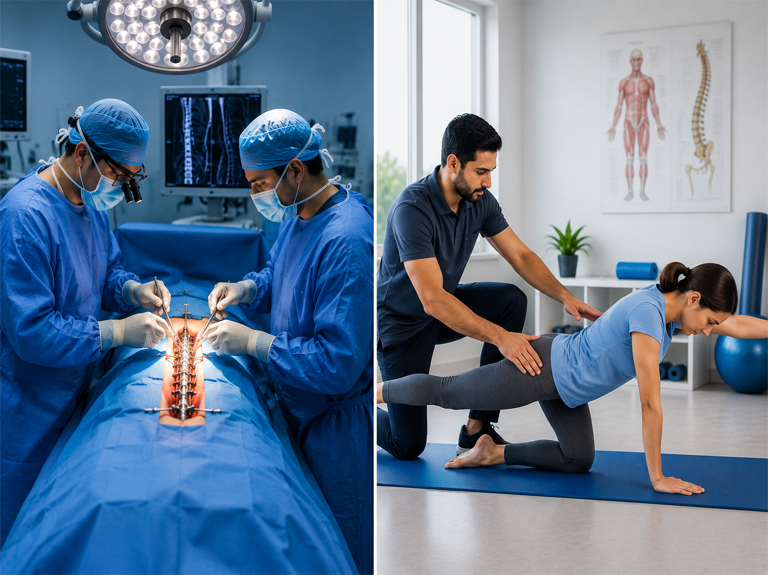
Spine Surgery or Physiotherapy? What a Senior Spine Specialist Looks for Before Recommending an Operation
Patients are worried: should I have spine surgery or can physiotherapy relieve my pain: back pain, neck pain, leg pain, numbness, or difficulty walking? Not all patients have the same answer. An operation is not typically prescribed based on an MRI indicating a disc bulge by a senior spine specialist. Non-surgical care is possible for most disc issues, and in some cases it is recommended to commence with non-surgical care unless there are signs of weakness, cauda equina syndrome or severe neurological changes.
Physiotherapy vs spine surgery: what is checked first?
When comparing physiotherapy vs spine surgery, the first question is straightforward: Is the issue with the spine painful but not damaging nerves?
A specialist tends to examine:
- Symptoms – Does the pain start in the back region, or does it extend to the leg or arm?
- Nerve action– Does the patient experience numbness, weakness, foot drop or loss of balance?
- Bladder/Bowel control– Emergency is indicated by loss of control.
- MRI and X-ray data– Are the reports consistent with the symptoms of a patient?
- Response to treatment: Has the patient already used medicines, physiotherapy, posture correction, rest, or injections?
- Influence on daily life– Does the patient walk, sleep, work, and handle his/her normal work?
That is why two individuals having similar results of the MRI might get different recommendations.
When physiotherapy may be recommended first

Physiotherapy is usually chosen in case of mild and moderate pain, no significant weakness, and the patient is capable of moving safely. In most cases of disc herniation, non-operative management is typically the primary therapy unless there is a neurological impairment. In other research, there is also evidence that, over time, pain from several acute disc-related nerve pains disappears.
Therapy can involve stretching, strength training, posture, walking program, core stability, ergonomic, and pain relief. It is not only meant to achieve temporary relief but to provide better support to the spine.
When A Specialist May Consider Spine Surgery

A spine specialist might consider surgery in cases when symptoms are severe, progressive or not responding to a reasonable amount of conservative management. Earlier surgery can also be thought about in a case of nerve compression that has commonly occurred alongside muscle weakness, bladder or bowel symptoms, spinal instability, severe stenosis, tumor, trauma, or deformity.
It is not a decision made out of fear. It rests on a belief that surgery can fix an evident structural issue more effectively than subsequent non-surgical therapy.
Why A Spine Surgery Second Opinion India Consultation Matters
A second opinion spine surgery consultation in India can be helpful when the patient has been recommended surgery but is still not convinced. It assists in the verification of the fact that the diagnosis, MRI result, symptoms and treatment plan coincide. It can also help explain whether physiotherapy, injections, lifestyle changes, or watchful waiting would be appropriate.
Reopine: Virtual Healthcare Consultations with Certified Senior Specialists
Reopine is a virtual consultation enabling patients to access certified super-experts in India to get safe first and second opinions. The platform also prioritizes consultation for new symptoms and the current diagnosis, and the listed doctors are government-registered with more than 15 years of experience.
Do I Need Spine Surgery?
Many patients are often concerned with the question: do I require spine surgery, or can I manage the problem without it? The resolution hinges on the symptoms, diagnosis, and the response of the body to non-surgical care, not only MRI findings.
The spine specialist usually examines:
- Intensity of the pain– Light to moderate pain can be treated using physiotherapy and medication.
- Nerve involvement: Numbness, tingling, or weakness can be signs that nerves are being compressed.
- Response to treatment – When the symptoms improve with physiotherapy and other forms of treatment, surgery might not be necessary.
- Impact on day-to-day life -The inability to walk, work, or carry out daily activities can drive one toward surgery.
- Red flag symptoms – Bladder/bowel control loss or severe weakness need immediate medical care.
Conclusion
Spine surgery is not the initial choice in most instances. Nevertheless, it can be required in case of severe symptoms or when the latter are not improving. An appropriate assessment and spine surgery second opinion consultation in India can assist you in making a safe and confident decision.